The LLMs are EVERYWHRE on the internet. People use it for writing homework, documentation, programming(I do too, it’s a useful tool), some companies use it for charging a lot to write reports like Delloite (6 months ago) provided a report with AI hallucinations to the Australian Government and KPMG pulled a report because of hallucinations in it. This post is about how AI/LLMs are growing across the internet.
Usage of AI
The usage of AI (mostly LLMs) has grown at a pace never experienced on the internet, in Google I/O 2026 Sundar Pichai said AI measured by token usage, has grown from 9.7 trillion tokens in May 2024 to 480 trillion and then to 3.2 Quadrillion tokens in May 2026, that’s 7 fold jump from 2025 to 2026. LLM usage does not seem to be going down at any noticeable rate. This is also primarily why the cost of hardware like RAM has gone up wayy too much, LLMs require a lot of memory to hold the Embeddings, Key Value matrices, etc. Micron Technology, one of only 3 major consumer RAM suppliers shut down their consumer brand, Crucial last year to cater to serving data centres. SK Hynix, another RAM supplier, announced bonuses of $400,000+ for it’s workers due to LLM generated demand. The demand is so high that in December 2025, Samsung Semiconductor refsued to service an order made by Samsung Mobile Experience!.
Side Note: Until Meta’s Threads App came along, ChatGPT held the record of gaining 100 million Monthly Active Users the fastest, reaching it in 2 months after launch (Threads did it in 5 days). To put this in context, Tiktok took 9 months to reach 100 million and Netflix took 10 YEARS to do the same, granted they started at the very beginbing of the Internet. The point of this note is to show that LLM usage is not tied only to programming, which is becoming the main focus right now, even before anyone thought to generate code from an LLM, usage had blown up.
The Data Problem
Forbes in this article talks about high quality training data from the internet may be running out, a lot of synthetic data is being used now to train the LLMs, as in already trained LLMs are generating data to train new LLMs (this feels like a bad idea). This can cause somewhat of an echo chamber effect. Epoch AI (a research non-profit) states that we may run out of human generated text between 2026 and 2032. This can be a serious problem
Internet Traffic
Matthew Prince, CEO of Cloudflare on June 03 2026, tweeted that Bot Traffic, he says due to agentic systems, for the first time in history had exceeded human traffic
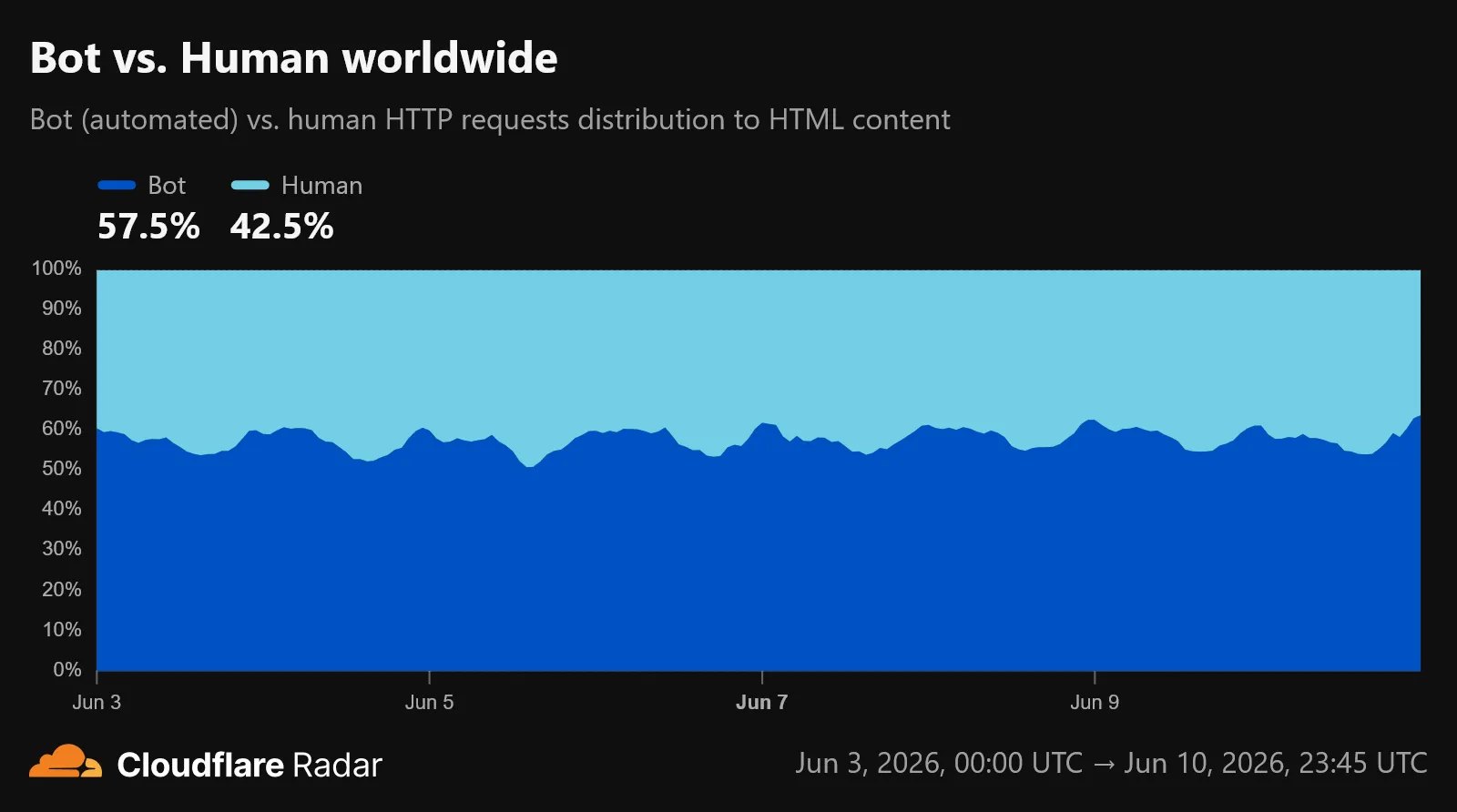
Even GitHub has had problems dealing with this exponential growth in traffic, stated in April, Github Blog. They have had multiple hour long incidents since then. Accross the web, many services have had to implement stricter rate limiting to counter this increase in AI bot crawling. GitHub are reported to be rebuilding all their infrastructure to handle this new era of coding agents. Like Shadertoy, a site to share GLSL Shaders, their API was down for quite some time and when it went back up, they added rules that only those who have used the platform for some time and have used the platoform positively with strict rate limits due to the voume of requests.
Cost of LLMs
The price of LLM API based token billing have decreased very much since they launched, as stated by Epoch AI but with the advent of AI Coding Agents like Cursor, Claude Code, the usage just exploded so much. Individuals can use the subscription models which are extremely subsidized by providers, like the Claude Max $200 per month subscription can give upto $8000 of usage (billed on API rates), same goes for the ChatGPT Pro 20x sub which is shown to give $10,000+ usage. These prices are insane and you will understand why when you think about what an LLM API call actually does. When you call an LLM API, actual GPUs have to take your prompt, tokenize it, run it through attention blocks, do many matrix multiplication depending on model size, etc, all of these have real costs associated and imagine all this done for all the tool calls, it’s not predictable or sustainable at all currently, but everybody seems to just believe the cost will keep getting lower. There are cost controlling techniques applied like Prompt Caching, which uses cryptographic proof to check if prompt input prefixes are unmodified and loads the precomputed KV caches into GPUs, and these cached input tokens are generally billed around one tenth the cost of normal input tokens but the cache-hit rate varies a lot by provider from what I have read.
Bad Budget Managment
People don’t realise that large companies cannot manage subscriptions for dev teams through the subsidized path due to various issues like compliance, data collection policies, etc. So, Anthropic offers a Team Plan and an Enterprise Plan, the Team plan allows managing upto 150 seats like subscriptions but the Enterprise Plan, which is the most used by companies other than startups, is a complete pay for every token on API rates system, which can dramatically increase costs. Here’s some examples of bad budget management that has happened this year (I think I will get the opportunity to update this list),
- The Gaurdian - In Reports say that Atlassian limited their AI Usage with caps ranging from 500 to 2000 USD, previously AI Weekly had reported that Atlassian’s AI cost had tripled by May 2026.
- Fortune - On Oct 25th 2026, 404 Media reported that, through an internal memo, Accenture is limiting central funding for project’s AI budget to $29 per employee, however Fortune reports that an Accenture spokesperson clarified that additional spending must be paid for by teams internal budgets or billed to clients but currently Accenture pushes it’s own clients towards AI integration, so feels like a catch-22 situation.
- Fortune - Uber spent their ENTIRE YEAR’S AI Budget in 4 MONTHS, when I read this I just could not comprehend how that can happen, what were they even doing, the Uber app has not changed in any significant measure.
- Yahoo Finance - Amazon shutdown their Internal AI leaderboard after the developers simply did as they were told to, “use more AI”.
- Polymarket - Meta also seemingly had a situation where due to gamified nature of thier leaderboard, Claudeonomics, led to more usage.
- Times Of India - Microsoft removed Claude models as default for Copilot internally and introduced budget ceiling for all divisions in July.
Also, Github Copilot switched to token based billing on June 1st, meaning when you buy a $20 a month Copilot subscription, you would get $20 worth of API billing based usage, which doesn’t really make sense why wouldn’t you just get them directly from the provider? And there’s OpenRouter as well, doesn’t that provide a lot more value? It’s not the most sense for capturing market share in an AI Tools loving economy but makes definitely more sense considering their finances, clearly this was long time coming, they had already removed premium models like Opus, Sonnet, GPT-5.3-Codex from the Copilot Student Plan because they cost a lot, and were disproportionately the most used models. They had also stopped new signups in April, as stated in the Github Blog
The Black Box Issue
Here, I want to talk about 2 incidents that I came across,
OpenAI made a post on the goblins and where they came from. Many users started reported that the GPT models would respond with lot of references to goblins, gremlins, other creatures, etc. This was funny, it would talk about goblins in conversations that were so far from them. They traced the issue back to GPT-5.1 training process where they had some reward for a “nerdy” personailty, from what I understand it’s like overfitting for the reward but the solution to curb the goblins in the mean time was hilarious, in OpenAI Codex the had a system message stating not to talk about goblins, gremlins, etc to fix the issue. (like the best engineers in the world and they had to solve it like this)
Codex Git Commit “Never talk about goblins, gremlins, raccoons, trolls, ogres, pigeons, or other animals or creatures unless it is absolutely and unambiguously relevant to the user’s query.”
Anthropic also had many reports from users who said Claude started saying it’s to sleep or get some rest. They could not even figure out the issue!(I have a conspiracy thoery)
To me both these problems highlight the fact that NO ONE knows how these models behave, completely unpredictable, how can we use these tools at this unsustainable pace that is being pushed by the AI Labs and trust them when they aren’t sure on how to solve such problems.
Anthropic Situation
Now, for the latest news, on April 7 2026, Anthropic announced Mythos Preview, a new class of ther models and said in their post that it had the best cybersecurity capabilities ever in LLMs. They had evidence to back it up too, Mythos Preview found many CVEs (Common Vulnerabilities and Exposures) in many important software projects like OpenBSD, the Linux kernel, etc. Then on June 9 2026, They released Mythos 5 and Fable 5. Fable 5 was a safe version of Mythos 5 which would not assist with any cybersecurity or advanced biology prompts and would fallback to a different model but on June 12 2026, the US Government declared Mythos/Fable 5 a national security threat, we don’t really know what made them take this decision, reports say Amazon broke the guardrails on Fable 5 and reported it. All this feels like a lot of marketing hype, I feel this way due to Aisle they are an AI cybersecurity company, they tested Anthropic’s claims against many different models and found all the same problems, they mention that they don’t chase hype and they have the credentials to back this up. Most recently, Aisle found 6 CVEs in the cURL project, affecting mainly libcurl applications not the command line tool. This is opposed to just 1 found by Mythos, that’s crazy, for all the hype Antropic are getting, for AI in cybersecurity seems like the model might not be the most important component.